
The next few months we’ll be highlighting authors who have published in Culture, Medicine, and Psychiatry.
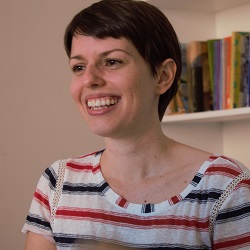
Cíntia Engel is a Visitor Scholar at the Institute for Bioethics & Health Humanities, University of Texas Medical Branch. She is a Brazilian medical and social anthropologist working at the intersection of the anthropology of care, Feminist Science and Technology Studies and Health Humanities. Her research interests include geriatric care, dementia, drug complexity in treating dementia, and policies of care in Brazil.
What is your article “Dementia, a Polypharmaceutical Phenomenon: The Intimate Combinations of Dementia Drugs in Brazil” about?
The paper discusses how symptoms of dementia entangle with the multitude of drugs used to treat it. To state that dementia is a complex condition is commonplace. The medical literature typically explains it by the disease characteristics, and social sciences highlight its multiple social and affective consequences. In the paper, I discuss how the complexity also relates to the treatment. Based on an ethnography of one year and a half (2017–2018) in a Brazilian metropolis, within a Public Geriatric center and the households of three families, I argue that dementia is a phenomenon enmeshed in polypharmacy. I open the text presenting the universe of drug consumption and its variety, then, through ethnography, I observe different levels of combination between medication in this complex treatment: (i) between themselves, (ii) with time, and (iii) with social relations, politics, and care practices.
Tell us a little bit about yourself and your research interests.
For as long as I can remember, I have been curious about how life and death keep happening as they do. I grew up in a small town in the interior of southern Brazil. Following the advice of a teacher, I went to the Federal District and graduated in social sciences at the University of Brasilia, where I did my Master’s in Sociology and my Ph.D. in Anthropology. My research intersects medical anthropology, care anthropology, and feminist science and technology studies. I believe that ethnography can enrich exchanges between these fields, expanding the analysis of the socio-material health phenomena, which is my main area of research. In this area, my topics of interest are the socio-material body, dementia, care practices, intersectionality in health, and the drug complexity of chronic treatments. The methodological perspectives of Annemarie Mol and Veena Das and the philosophical imagination of Donna Haraway inspire my thinking and writing.
What drew you to this project?
During my Master’s degree, I researched care and Alzheimer’s disease, observing the exchanges and conversations of support groups for caregivers and newly diagnosed people. The topics of conversations covered dilemmas such as managing symptoms, finding acceptance, and dealing with the challenges of daily care. To my surprise, a recurring theme was drugs prescribed by physicians to deal with dementia and other comorbidities. Caregivers used to mention many drug names and share experiences and agonies about them. The mediators of the groups were social workers, psychologists, and occupational therapists. Despite being very familiar with drug conversations, they did not feel in the proper position to advise about it, so they organized the presence of a pharmacist at a meeting. It was one of the most crowded meetings I witnessed, and many participants spoke that day. At that moment, I was not able to discuss the role of medication in care, but I decided I should study it for my Ph.D.
What was one of the most interesting findings?
Once I started my research with geriatricians, I introduced myself as an anthropologist interested in studying Alzheimer’s disease and its medical treatment. However, they told me that perceiving medicines and diagnoses in isolation were insufficient. They taught me I needed to know the combination of diseases and substances used in each situation to discuss the medical treatment. One of their challenges was to deal with ‘drug interactions’: combinations of substances that could modify effects by intensifying, decreasing, or generating a dangerous side effect. They also taught me that caring for the ‘interactions’ was imperative in complex cases in which dementias combine with a series of other chronic diseases or even with social and financial dilemmas—and most dementia treated there were complex cases. I took this “native” notion of drug interaction and decided to play with it through its multiple consequences in care practice. There is more than one drug at work in most dementia cases, and they interact. By acknowledging the multitude of drug interactions, I argue that a polypharmaceutical phenomenon enacts dementia.
What are you reading, listening to, and/or watching right now?
I am reading a beautiful book that teaches me about vulnerability and the complex relationships of love and care. The Vietnamese American and Queer poet Ocean Vuong writes “On Earth, We’re Briefly Gorgeous” as if it was a letter to his mother, who cannot read. He harbors the violent outbursts of a mother traumatized by war and immigration while finding a way to embrace himself fully. It is a strong, sensitive, hurtful, and hopeful book.
I recently moved to the United States, and I am feeling a bit homesick, I have been listening on repeat the album Canto de Praya, by Hamilton de Holanda and Mestrinho. It is Chorinho, a musical genre that warms my heart.
If there was one takeaway or action point you hope people will get from your work, what would it be?
The most direct takeaway would be assuming that drugs are social beings that interact and probably rethinking dementia medical treatment to deal carefully with these relations.
I would also state the known yet necessary point that caring for dementia should be a collective concern, not centered on families, drugs, or institutions alone. We need more infrastructure of care and awareness for people with dementia to be themselves and live the best life possible.
Other places to connect:
Twitter
LinkedIn
ResearchGate
 Culture, Medicine, and Psychiatry