
The next few months we’ll be highlighting authors who have published in Culture, Medicine, and Psychiatry.
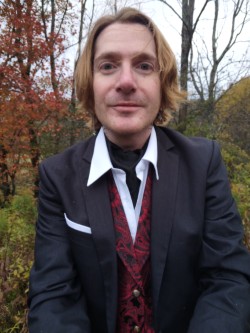
Wren Ariel Gould (they/them) is a PhD Candidate at the Dalla Lana School of Public Health at the University of Toronto. They leverage critical political economy, critical rural studies, and critical psychiatry in considering LGBT mental health, with their research addressing this vital intersection (e.g. anti-trans health legislation, rural-urban movement).
What is your article ““Living Dead”: Trans Cooperations with Mad Necropolitics and the Mad Trans Coalitions that Might Replace Them.” about?
This article is first about how the eugenicist investment in “public hygiene” that led to widespread abuse of mad peoples through the early 20th century in the U.S. has been transmuted and rearticulated over the past 50 years (since deinstitutionalization), such that the U.S. welfare state and prison industrial complex augment traditional psychiatric hospitalization, ultimately continuing to undermine the viability of mad lives. However, these “mad death worlds” are considered in the context of trans depathologization efforts that often continue to endorse a medical lens that renders madness a “mental illness,” albeit with transgender subjectivity an exception. The article considers these depathologization efforts in the context of recent anti-trans legislation efforts and reiterates a coalitional/intersectional approach whereby mad, trans activisms may be more productive for mad and/or trans liberations.
Tell us a little bit about yourself and your research interests.
I’m interested in queer and trans mental health viewed from a few critical perspectives, especially critical political economy. On the one hand, that means I’m interested in how U.S. states are trying to assume control over trans healthcare, especially from the perspective of a thorny political context in the U.S. But I’m also interested a broader U.S. political context and what it means for queer and trans mental health, mainly U.S. divisions between rural and urban spaces. I’m particularly interested in ideas about how urban spaces are (relatively) safe for queer and trans people, with more recent research considering how narratives of rural incompatibility with queer/trans life sometimes overlook or participate in a U.S. political economy that marginalizes rural places and peoples.
What drew you to this project?
This project emerged from a few places. First, it was inspired by my years in community (and forensic) mental health from 2012 to 2021. Throughout that time, I tried to incorporate critical psychiatric approaches into my work such that a guiding principle for me was that my perspective was not more valid than the individuals I served, who often were voices’ hearers or saw the world differently from how I did. Any attempt to destabilize those power asymmetries (between service provider and user) were often stymied by the medicalizing frameworks adopted both by service users and organizations. More, though, I witnessed how devastating social conditions, rather than “mental illness,” affected quality of life. Service users (I don’t know that anyone I served would want to be considered “mad”) were often creative and resourceful in the face of sanist architectures, so it would be a mistake to think of them as victims. But recent critical theory offered new language to name these sanist architectures as necropolitical, as disallowing life. This project also emerged from my positionality as a trans service provider, as I saw trans voices’ hearers and others with “severe mental illness” as being left behind by trans movements. The move to insist that being trans wasn’t a mental illness often implied a contrast with mad people, who had “real mental illness,” like schizophrenia. Those moves had devastating consequences for trans voices’ hearers, since their trans identity was under more scrutiny and suspicion. I wondered if a more productive pathway might be validating both trans and mad people as knowers.
What are you reading, listening to, and/or watching right now? (Doesn’t have to be anthropological!)
I just finished Jeff VanderMeer’s Absolution, which was a fitting addition to his weird fiction Southern Reach series (he has been described as the “weird Thoreau” by The New Yorker). The novel returns to the world of Area X, in which alien technologies hybridize all organic matter, leading to surprising transformations. Though these technologies are destabilizing, the chaotic ecologies that emerge only pose an “existential threat” to corrupt government intelligence agencies, as Earth abides. In Absolution, VanderMeer seems to ask what the terms of forgiveness are, both at the interpersonal level, but also on the scale of the Anthropocene. Otherwise, I’m finally getting into the newest volume of Monstress, a fantasy graphic novel set in an alternate, matriarchal, pan-Asian setting that follows Maika Halfwolf, a teenager with a symbiotic relationship with an Old God who becomes embroiled in a war with the genocidal Cumaea (human witches).
If there was one takeaway or action point you hope people will get from your work, what would it be?
When trans depathologization efforts leave mad people behind, they may unintentionally reinforce systems that undermine the viability of mad lives. The latter may even be self-defeating if trans depathologization efforts are unconvincing, such that a politics informed by trans and mad perspectives may be more productive.
Other places to connect:
Website
 Culture, Medicine, and Psychiatry