
The next few months we’ll be highlighting authors who have published in Culture, Medicine, and Psychiatry.
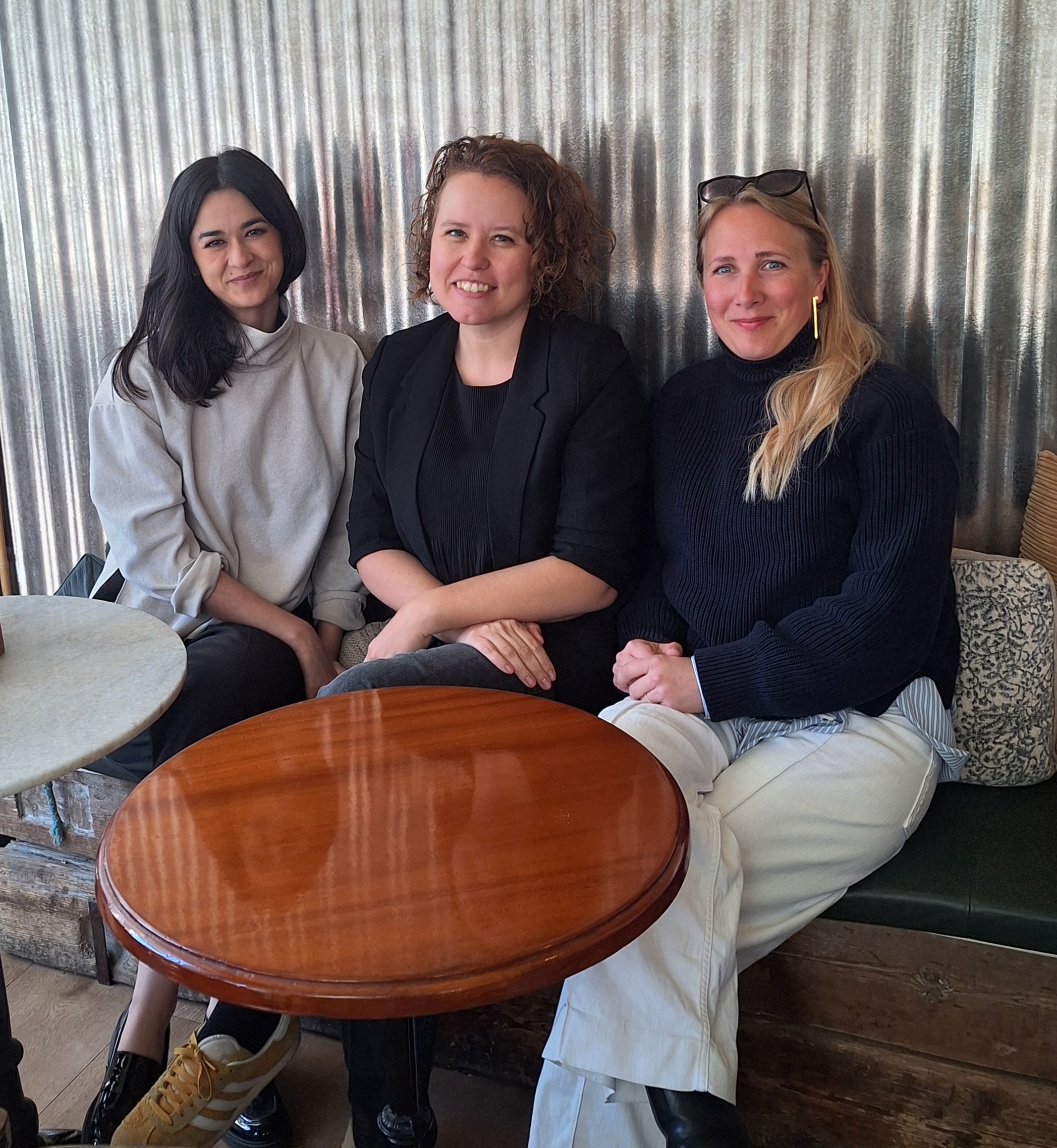
Today, we are excited to bring you our interview with Mia, Elizabeth & Alex!
What is the article “Enacted Restoration of Selfhood: A Kierkegaardian Perspective on Self-harm Among People with Mental Illness” about?
The article is an exploration of the lived experiences of individuals engaging in non-suicidal self-harm and shows how self-harm is not only the experiential nexus of a complex relationship between the body and the world but also a mechanism for overcoming the self. Whereas self-harm within the context of mental illnesses has traditionally been researched and understood as symptomatic behavior, our contention is that self-harm can be described through the lens of ‘enacted selfhood’ as an analytical framework inspired by Søren Kierkegaard’s existential thought for shedding light on what more is at stake in self-harm among individuals living with mental illness.
Tell us a little bit about yourself and your research interests.
Alex: I’m a social anthropologist with a focus on critical analysis of mental health and health services, particularly overuse and overdiagnosis. My work examines how diagnostic categories, practices, and technologies are produced and negotiated, and how they shape lived experiences, sustain promissory visions of biomedicine and generate broader questions of inequality and care.
Anne Mia: I’m a social anthropologist working within social psychiatry and welfare institutions. My research focuses on people living at the margins of welfare systems, attending to experiences of loneliness, not belonging, and everyday life under institutional conditions. Grounded in phenomenological approaches to the body, I explore how lives are shaped through movements between spaces, relations, and forms of care. Methodologically, I work ethnographically and with multisensory approaches to make present forms of experience that are often rendered difficult to articulate, asking how they are navigated, resisted, and reworked in practice.
Elizabeth: I’m a philosopher of religion and a Kierkegaard scholar, with particular interest in his concept of existence and critiques of systematic philosophy, the problems of conceptuality, and the relation between religious faith and reason as well as the development of existential thought more generally in 19th and 20th century European philosophy and theology.
What drew you to this project?
This article is a collaborative and interdisciplinary project between the three of us, but it was developed over different stages. Alex and Anne Mia conducted different field works on two different projects, both centering on lived experiences with mental illness. We’ve known each other since our university days and often discuss theoretical or empirical challenges. We both became curious when we noticed how conversations with interlocutors about their experience and reflections on non-suicidal self-harm did not seem to reflect the way in which this phenomenon has traditionally/predominantly been treated in existing research. Here self-harm remains marginalized both analytically and empirically as it is viewed as a mere symptom among individuals living with mental illness or “call for help”. However, what we, Alex and Anne Mia, experienced in fieldwork, showed that there was something more at stake in the question of self-harm: It took up a lot of space in conversations with individuals who self harmed, who had profound and extensive reflections on the way they experienced this, thought about it, and enacted it with many expressing it to be an act of deep existential import.
Alex later invited Elizabeth to collaborate, after hearing her speak about Søren Kierkegaard at the Young Academy of the Danish Royal Society, which we are both fellows of. Upon discussing the project, it became clear to us that Kierkegaard’s concept of existence and selfhood and his proto-phenomenological and existential approach could offer a theoretical framework that could encompass/shed light on the individuality, existential complexities and the many ambiguous and paradoxical ways self-harm was reflected on and described by individuals in their lived experience of engaging in self-harm.
The article is thus the result of a discovering deeper and mutually illuminating connections between our research interests and bringing these together in this joint interdisciplinary effort.
What was one of the most interesting findings?
That self-harm is not merely a call for help or a means of translating or displacing psychological pain into physical sensation; rather, it may be understood as an example of what we term “enacted selfhood.” While the linguistic and discursive dimensions are often foregrounded within social recovery frameworks, this research underscores the importance of attending to concrete, embodied experience. The body, too, articulates meaning: self-harm constitutes a form of expression to which we ought to remain attentively and analytically responsive.
What are you reading, listening to, and/or watching right now?
Alex: I have been reading Glenn Bech’s Jeg anerkender ikke længere jeres autoritet (I No Longer Recognize Your Authority) which poetically explores experiences of societal inequality. I am the first in my family to even graduate from high school and his words really reflect my own experiences in childhood, but also broaden my understanding of the deep humanity present in the most difficult lives and fates among my interlocutors. I’ve been listening to Mahler’s “Symphony No. 3”, which I’ll be going to hear performed by Tivoli Copenhagen Phil & Odense Symphony Orchestra next month (and Elizabeth will join me!) but I generally like all kinds of music and am a very dedicated euphonium player in Copenhagen Brass Band.
Anne Mia: I am currently reading The Museum of Innocence by Orhan Pamuk, which explores the relationship between the affluent Kemal and the less privileged Füsun, and how Kemal assembles a collection of objects, such as one hundred cigarette butts, that come to narrate the story of their love. The novel simultaneously functions as a key to a physical museum, blurring the boundaries between fiction, materiality, and exhibition. Reading this work serves in part as inspiration for a current research grant application, as I am particularly interested in modes of dissemination and in how anthropological inquiry might intersect with aesthetics and literary form.
I have been listening extensively to Bach lately; and, as a mother, I have, perhaps less voluntarily, been accompanying my child’s engagement with Melodi Grand Prix, Denmark’s children’s version of Eurovision.
Elizabeth: I recently finished Ben Lerner’s new novel Transcription and just started re-reading Plato’s Dialogues. The next work of fiction I’ll be picking up is Anne Mia’s YA novel Akio from 2021, which very presciently explores a romantic relationship with an AI. As a Kierkegaard scholar, I’m endlessly fascinated with the struggles we humans have in communicating our thoughts and inner lives, and the ways in which our technology and media for communication can hinder and complicate our relationships with and understanding of ourselves and others. I keep coming back to Wagner’s Tristan und Isolde, but I have also been listening to a lot of David Bowie and Wet Leg these past weeks. In between comfort-(re)watching The Office and Gilmore Girls, my most recent trip to the cinema was to see Kristoffer Borgli’s The Drama.
If there was one takeaway or action point you hope people will get from your work, what would it be?
Not to dismiss or take for granted certain phenomena, behaviors or actions, but recognize the limits of categorization: As our exploration of self-harm shows it is necessary to take into account the individual and the particular context, which at the same time is not something we can simply understand and explain once and for all. As Kierkegaard underlines to try to turn human experience into circumscribed, universal concepts results in dissolving the reality we are attempting to grasp, because our concrete embodied existence as individuals is in movement.

