News: WHO Release on Worldwide Hearing Loss

When medical anthropologists consider the impacts of technology on human health, we envision life-saving drugs, surgeries, or diagnostic tools to detect disease. Technology in these ways can prove instrumental– quite literally — in improving patients’ health outcomes. However, it is equally important to think about the ways in which technology can diminish health, particularly in an age where the global spread of technology deserves the attention of clinicians and anthropologists alike.

This is the nature of the concern posed by the latest World Health Organization (WHO) report, released on February 27th 2015. After studying noise exposure in middle and high income countries and among participants ages 14-35, WHO officials stated that an estimated 1.1 billion people are at risk for hearing loss due to “recreational noise.” This includes music piped through headphones and noise experienced at entertainment venues. Exposure to high decibels of sound is not itself harmful: for instance, hearing a heavy pot fall from the counter and crash onto the floor would not cause hearing damager. Rather, the extended length of exposure to such loud noises is what proves detrimental. The WHO defines dangerous levels of noise exposure as 85 decibels for eight hours or 100 decibels for 15 minutes. The report notes that a rock concert that lasts for two hours may cause temporary hearing loss or lead to other symptoms such as a ringing sensation in the ears, and regular extended exposure may lead to more permanent damage.
The WHO flag, via Wikimedia Commons

The WHO flag, via Wikimedia Commons

What does the WHO recommend to address this global health concern? The report singles out teenagers and implores them to take noise management into their own hands: purchasing noise-canceling headphones, taking “sound breaks” if extended exposure to loud sounds is unavoidable, or wearing ear plugs to loud music venues. This places the responsibility to manage noise exposure on young people rather than on their families and caregivers. Likewise, the report suggests that patrons of entertainment venues like clubs and bars that feature loud music and sounds should limit their time spent in such environments. There are no extensive recommendations listed in the report for those who work in loud venues, other than limiting shifts to eight hours to shorten exposure.

From a medical anthropological standpoint, many of the factors in sound environments are tangled with social life. For instance, in many developed countries, concerts are an important social gathering place for young people. Teens may not avoid these events, but if they follow the WHO recommendations and wear earplugs to the venue, they may be ostracized by their peers for looking out of place. Likewise, neighborhood bars and clubs are important hubs of activity for locals, and avoiding them may come at the cost of social isolation. As technologies spread both to developing and developed countries, the ways that people integrate audio technologies, new entertainment venues, and popular music into their lives is worth considering given the impacts of these tools, sounds, and social spaces on hearing health.


To read the WHO’s news release, click here: http://www.who.int/mediacentre/news/releases/2015/ear-care/en/
Book Release: Haeckel’s Embryos by Nick Hopwood

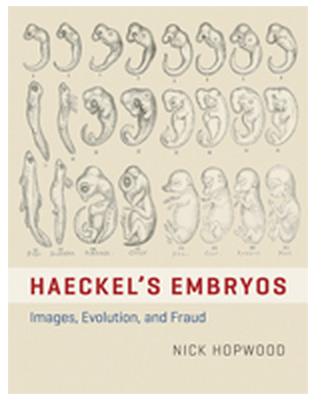
Debuting May 2015 from the University of Chicago Press is Nick Hopwood’s Haeckel’s Embryos: Images, Evolution, and Fraud. The book describes the lasting cultural impact of 19th-century illustrations that demonstrate the identical appearance of human and other vertebrate embryos in the earliest stages of gestation, only later morphing into their adult-like forms. These drawings, produced by Darwinist Ernst Haeckel in 1868, caused an uproar in the scientific community at the time as well as in the 1990s, when biologists and creationists alike argued against their accuracy and inclusion into scientific textbooks.

Image courtesy University of Chicago Press

Image courtesy University of Chicago Press

Hopwood traces the heated history of Haeckel’s drawings from their initial publication in the 19th century through their controversial presence in the current age. In addition to considering the impact of these images on developing understandings of biology, Haeckel simultaneously draws attention to the continued power of these images in contemporary discourse. The book will prove of interest to scholars of medicine who are curious about how popular as well as scientific knowledge of the human body is shaped by visual media, as well as how scientific information is culturally and historically situated.

Nick Hopwood is Reader in History of Science and Medicine and the Director of Graduate Studies at the University of Cambridge’s Department of History and Philosophy of Science.


To learn more about the book, check out its feature page at UCP here: http://www.press.uchicago.edu/ucp/books/book/chicago/H/bo18785800.html

From the Archive: Biotechnology and the Culture of Medicine

In the “From the Archive” series, we highlight articles published throughout the journal’s history. We look forward to sharing with our readers these samples of the innovative research that CMP has published on the cultural life of medicine across the globe.

cards3

In this installment of From the Archive, we turn to Mary-Jo Delvecchio Good’s article The Biotechnical Embrace (Vol 25 Issue 4, December 2001.) In this piece, Delvecchio Good frames three concepts in the cultural study of biomedicine: medical imaginaries, biotechnical embraces, and clinical narratives. Here, we will briefly outline these notions.

The medical imaginary, we learn, is the envisioned potential of the new technologies and treatments that medicine could produce in the future. The power of possibility in this sense impacts both clinicians, who are always working to stay ahead of new scientific knowledge, and patients: often those afflicted with diseases for which no current remedy exists. The medical imaginary situates medical progress in a position of hope and opportunity. Stories of medical failure, malpractice, or dearths of medical knowledge, although evidence contrary to establishing an “optimistic” view of the field, are framed in an overarching positive narrative of scientific progress.

Delvecchio Good next describes the biotechnical embrace: the embracing of, and the “being embraced” by technical innovations. This refers to the public “enthusiasm” for biotechnical therapies, as well as the engagement of biotechnologies with the patient’s body. Like the medical imaginary, the biotechnical embrace concept recalls a biomedical commitment to scientific progress and possibility. Even whenever a treatment is highly experimental, not yet approved as effective, or so new that its pitfalls are not fully known, patients will ’embrace’ and request it– and the public will hastily invest in it.

Lastly, we parse the concept of the clinical narrative, or ethnographic frame. This qualitative data is what evidences popular and clinical enthusiasm for bioscientific innovation and the use of the latest technological treatments.

Put simply, narratives can demonstrate that patients and clinicians alike are able to frame care in terms of the gap between what is presently the case, and what might be. For instance, a cancer patient might note the gaps between their condition, current treatments they have used, future therapeutic options, and subsequent clinical outcomes for his or her illness. Clinical narratives remind us that patients (and caregivers) do not view medicine as a static database of information, but instead a dynamic and progressive body of knowledge that exists in relation to illness experiences.


Click here for a link to the abstract and further details about the paper: http://link.springer.com/article/10.1023/A%3A1013097002487

AAA 2014: Perspectives on the Bruno Latour Distinguished Lecture

This year at the American Anthropological Association 2014 Meeting, Bruno Latour was invited to deliver the distinguished lecture. Entitled “Anthropology at the Time of the Anthropocene,” Latour discusses the rise in the term anthropocene to describe our current stage of natural history. Although the term makes reference to how “human” (anthro) our current age may be, Latour jests that this term was introduced by geologists, not social scientists. In the anthropocene, it is humans that play the defining role in our geological historical moment.

The assumption, Latour notes, is that human agency is the prime source of action that shapes the physical world. Humans are responsible for climate change, for pollution, for altering the literal, natural fabric of our world. Yet we know that not all humans have the same impact on our environment. As Latour quips, there is not “One Human” who is responsible for the changes we see in our climate or environment. We are simultaneously assessing human power as a plural, collective entity, as well as using this concept to suggest that the blame for global change does not fall evenly across all humans. As anthropologists and cultural theorists, we know how fragile human agency can be when we divide it amongst many contending social and cultural groups.

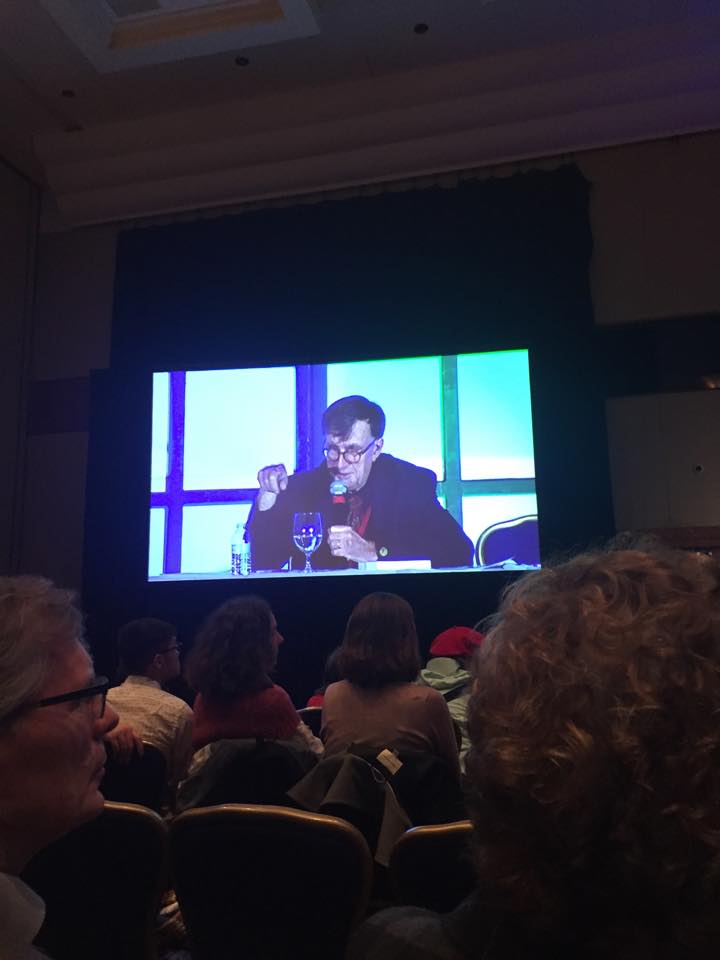
Our blog editor at the Latour Distinguished Lecture

Our blog editor at the Latour Distinguished Lecture

Is there another way to think about human action that does not problematically configure humans as both collective and individual, acting but not universally accountable for all human actions? Latour posits that rather than focusing solely on agency, with a strong emphasis on human intention and purpose when committing action, we could think instead about animation, or what forces–human and non-human– are in motion in a given social space. To do so, we can no longer assume that the human agent is a colloquial be-all-end-all.

How does this assertion speak to medical anthropology, social medicine, and medical humanities? At first, we might raise our brows at the discussions of geography, environment, and most of all the suspicion surrounding the primacy of human agency. Decentralizing the human agent, we might say, is perhaps the least humanistic approach to the study of human experience. Indeed, medicine is the care of humans by humans!

However, our human ability to question our own power and position in the universe, amidst other natural and non-human forces, is a mark of our species. Whether through philosophy, religion, or social science, humans have a proclivity for ruminating about our place in the material, corporal world. We crave knowledge about what sets us apart from non-human things, and how we are sometimes reliant on them. For scholars of medicine, such inquiries about our relationships with the physical universe is key. We consider the place of non-human agents in disease and care. We ask: why do physicians rely on certain tools? Why do patients see stethoscopes, thermometers, and scalpels as making a clinician legitimate in his or her practice? How are medical traditions made unique by their tools and pharmaceutical formulas? Could the layout of a hospital or clinic itself alter the way care is given?

In an age where technology permeates developed and developing societies, Latour’s suggestion to destabilize human agency is productive when considering medicine as a cultural object. We must think not only of ourselves, but the physical environments we live in and the material objects and devices we cannot seem to live without.

Many scholars understandably resist Latour’s idea that non-humans could have some primitive agency. Yet even if we do not assign agency to non-human tools, things, and environments, thinking seriously about their role in sociocultural systems is informative. Medicine is a lively site of exchange between patients and physicians, as well as practitioners and devices, patients and new medical innovations, and the built environments which house them. As Latour invites us to do, we should pause to consider humans within the midst of a rich material world around us that– like humanity itself– is constantly in motion.

Julia Balacko is a second-year PhD student in medical anthropology at Case Western Reserve University. She holds an MA in Humanities from the University of Chicago. Her research focuses on the culture of human anatomy and dissection in Western medical traditions, as well as public access to anatomical and pathological specimens.


Note on the presenter:

Bruno Latour is professor at the Sciences Po Paris in Paris, France. A central theorist in STS (science and technology studies), he is the author of We Have Never Been Modern (1991), Science in Action (1987) and Laboratory Life (1979).

You can read the full text of Latour’s lecture here: http://www.bruno-latour.fr/sites/default/files/139-AAA-Washington.pdf