Current Issue: Preview of Books Received, Part Two

In this special feature on the blog, we’re highlighting recent book publications that have been submitted for review to Culture, Medicine, and Psychiatry. This week, we are pleased to present a short overview of Making and Unmaking Public Health in Africa: Ethnographic and Historical Perspectives, a volume of works edited by Ruth J. Prince and Rebecca Marsland. This book addresses the experience of African public health initiatives from numerous vantage points. Published by the Ohio University Press, a paperback version was released in December 2013. You can learn more about the book here: http://www.ohioswallow.com/book/Making+and+Unmaking+Public+Health+in+Africa.
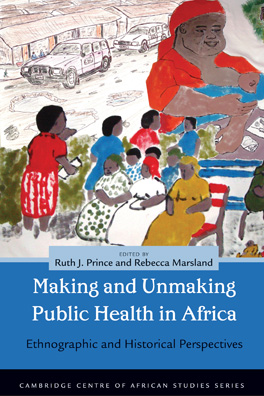
Book cover image via the Ohio University Press website.

Book cover image via the Ohio University Press website.

Prince and Marsland’s edited collection was the result of a 2008 workshop at the University of Cambridge hosted by the Centre of African Studies and the Department of Social Anthropology. Africa has long served as an “arena” for discussions about global health, human rights, and humanitarian aid, but the notion of health-for-all is complicated against a backdrop of African state formation, international interventions, and transnational policies.

This text explores what public health means for clinical professionals, patients, government officials, and citizens throughout Africa. Instead of generalizing what the meaning of public health to these groups might be, this book aims to establish a rich, complex anthropology of African public health that weighs the importance of politics, culture, and local understanding to the definition and delivery of public health initiatives. The volume covers topics in numerous countries including Uganda, Nigeria, Kenya, and Tanzania, and takes a blended historical-anthropological approach to studying public health.


These brief summaries are intended to give our readers a glimpse into the newest academic publications that we’re excited to discuss in our journal and with our followers on social media. For a full list of books that have been submitted for review at CMP, click this link: http://link.springer.com/article/10.1007/s11013-014-9383-x. This page also has information regarding the submissions process for authors who’d like their academic releases reviewed in the journal, as well as information for those interested in composing a review. For more information on this process, please contact managing editor Brandy Schillace.

Current Issue Highlight: September 2014 (Vol 38 Issue 3) Part Two

Welcome back to our two-week special update featuring glimpses into some of the articles published in the latest release of Culture, Medicine, and Psychiatry. These brief synopses of a few of our newest pieces from the September 2014 issue are only some of the publications that the current issue has to offer. We hope they invite you to explore the many other fascinating articles housed in this issue and in past volumes of CMP.

Swapnaushadhi: The Embedded Logic of Dreams and Medical Innovation in Bengal
Projit Bihari Mukharji

Mukharji’s article discusses the prevalent but little-researched history of indigenous therapeutic practices in Bengal that stem from therapies revealed in healers through dreams. Instead of grouping this practice into the indiscriminate category of “indigenous practice” or “dream culture,” the author asserts that all dream cultures are locally specific. They also do not draw stringent religious boundaries, as healers (and their patients) may receive visions of divine figures like Jesus or Muhammed despite not being of the creed the prophet represents. Because of this cross-cultural and “borderless” dialogue, medical innovation in dream medicine occurs regularly as the product of contact between numerous religious, spiritual, and local traditions. As Mukharji argues, “the logic of dreams opens up a space: the swapna-sthana or the dreamland where such cross-boundary transactions can take place without undermining the sanctity of the boundary itself in everyday social life.”

‘‘Pensando Mucho’’ (‘‘Thinking Too Much’’): Embodied Distress Among Grandmothers in Nicaraguan Transnational Families
Kristin Elizabeth Yarris

Yarris chronicles the difficulties faced by Nicaraguan grandmothers serving as the primary caregivers of grandchildren whose mothers have migrated to another country for employment. The author asks us to reconsider the simplistic mind-body connection in lieu of a more complicated view of the body and mind as experiencing distress: physical, emotional, and cultural all at once. In this paper, we discover that the term “thinking too much” ultimately describes the difficult self-sacrifice faced by grandmothers who tend to their grandchildren to allow their own children to succeed elsewhere. The stress of geographically dispersed and fractured families, the burden of caregiving later in life, and anxieties surrounding the grandmothers’ “hopes for the future” generate a particular form of psychosomatic suffering connected to broader economic, social, and political pressures manifested at the local level among these Nicaraguan families.

News: “Uncontacted” Tribes Emerge in Brazil

As reported by the BBC, the Brazilian organization FUNAI (which handles affairs of indigenous people within the country) released a statement on July 1st 2014 stating that seven members of an isolated tribe entered a village on the Peruvian border and made “peaceful contact” with the locals.[i] The group has been referred to in news media as an “uncontacted” tribe because of its formerly limited interaction with settled society outside of the Amazon rainforest, where the group makes its home.

This image of two members of the tribe was released by the Brazilian organization FUNAI.

This image of two members of the tribe was released by the Brazilian organization FUNAI.

The reemergence of this tribal group proves to be a source of enlivening discussion for scholars of the culture of medicine. The American Association for the Advancement of Science—the organization behind the journal Science—published a news piece that the tribal people “first exhibited flu symptoms on 30 June, 3 days after their first meeting with government officials in the Brazilian village of Simpatia.”[ii] After returning to the town, the article notes, the group was met by a medical team who administered flu vaccines and held them for six days at a treatment facility. They hoped to stop the disease from being transmitted to fellow members of the tribe, who due to infrequent contact with the villagers, could lack established immune defenses against the illness.

Another piece from Forbes news describes this interaction in further detail. “Doctors were flown in to the remote village and were able to talk to the nomads through an interpreter who knew a similar language, persuading them to take medicine that helped them to recover before they went home to their people,” the piece explained.[iii] The author also cites Carlos Travassos of the FUNAI organization, who remarked that, “at first [the tribal people] were afraid and wary, but thankfully in the end they understood, believed us, trusted the medical team and accepted the medicine…it was a difficult and slow dialogue.” The case therefore highlights the cross-cultural impact of medical treatment and the possible problems of delivering care that is non-native to the patients.

This news invites us to revisit postcolonial theory and to weigh the relationship between the settled, modernized world with that of local natives who have sustained their lifestyle alongside globalized societies which they come into contact with. It also suggests that the notion of the exotic “other,” and romanticizing of tribal life, remain objects worthy of introspection and critical interest.


[i] Newar, Rachel. (August 4 2014). Anthropology: The sad truth about uncontacted tribes. BBC News. http://www.bbc.com/future/story/20140804-sad-truth-of-uncontacted-tribes


[ii] Pringle, Heather. (July 25 2014). Did Brazil’s uncontacted tribe receive proper medical care? American Association for the Advancement of Science News. http://news.sciencemag.org/health/2014/07/did-brazils-uncontacted-tribe-receive-proper-medical-care


[iii] Rodgers, Paul. (July 20 2014). Indians Emerge From Jungle, Catch Deadly Flu. Forbes. http://www.forbes.com/sites/paulrodgers/2014/07/20/indians-emerge-from-jungle-catch-deadly-flu/

News: 2015 Conferences in Cultural Studies of Medicine and Medical Humanities

The following is a list of conferences in 2015 with upcoming submission deadlines in the fall. If you are a conference organizer or have a conference you’d like to share in the fields of medical anthropology, medical humanities, or the social science of medicine, please email blog editor Julia Balacko at jcb193@case.edu with the location and date(s) of the conference, as well as submission deadlines. Conferences are listed by the date they will be held.

Medical Humanities for Drew University Transatlantic Connections Conference

January 14-18 2015 Donegal, Ireland

Deadline for submissions: Nov 1st 2014

Ageing Histories, Mythologies and Taboos: CFP Interdisciplinary Conference

University of Bergen, January 30th-31st 2015

Deadline for submissions: Sept 1st 2014

Vesalius and the Invention of the Modern Body

February 26-28th 2015

Washington University in St. Louis and Saint Louis University

(No submissions – invited speakers)

Playing Age (Anthropology and Gerontology)

University of Toronto, Feb. 27-28, 2015

Deadline for submissions: Sept 5th 2014

Medicine and Poetry: From the Greeks to the Enlightenment

March 20th, 2015 University of Miami Coral Gables, Florida

Deadline for abstracts: October 3rd, 2014

The Examined Life Conference: Writing, Humanities, and the Arts of Medicine

The University of Iowa, April 16th-18th 2015

(No submissions- workshop-based conference)

The American Association for the History of Medicine Conference

New Haven, CT, April 30th-May 3rd

Deadline for abstracts: Sept 26th 2014

Welcome to the Culture, Medicine, and Psychiatry Website

From all of us on the CMP Journal editorial board, we’d like to extend a few opening words as we launch our new homepage.

This website will feature important information about the article submission process to the journal, as well as detail the newest installments of the journal’s current issue. It will also feature updates on the latest publications in the field of medical anthropology and allied work in the medical humanities, as well as current events that impact our understanding of human health and illness experience throughout the world today. More extensive blog posts exploring the cultural dimensions of medicine and health will be posted to this site as well, composed both by our blog administrator as well as guest writers.

It is our hope that the website will provide an active hub for scholarly work and contemporary trends in medical anthropology and the cultural study of medicine. We thank you for visiting our site and invite you to return for continued updates!

Best wishes,

Atwood Gaines, MA, MPH, PhD

Brandy Schillace, MA, PhD

Catherine Osborn, BA, BS

Stephanie McClure, MA, MPH, PhD

Ariel Casciso, BA, MA

Julia Balacko, MA (blog editor)