Publication Highlight: “Online First” Articles (Oct 2014), Part One

The following collection of articles are from our “Online First” file at our publisher’s website: http://link.springer.com/journal/11013. The full text of these articles will be released in upcoming issues of Culture, Medicine, and Psychiatry, but here we’d like to lend our readers a glimpse into the innovative research in medical anthropology and social medicine that the journal publishes.

Clicking the title of each paper will send you to the “Online First” page for each article, including a full list of authors and abstracts.

cards

A Village Possessed by “Witches”: A Mixed-Methods Case–Control Study of Possession and Common Mental Disorders in Rural Nepal

Ram P. Sapkota, et al

Practicing and Resisting Constraint: Ethnography of “Counter Response” in American Adolescent Psychiatric Custody

Katherine Hejtmanek

The Invisibility of Informal Interpreting in Mental Health Care in South Africa: Notes Towards a Contextual Understanding

Leslie Swartz & Sanja Kilian

Learning Disabilities’ as a ‘Black Box’: On the Different Conceptions and Constructions of a Popular Clinical Entity in Israel

Ofer Katchergin

Current Issue: Preview of Books Received, Part Two

In this special feature on the blog, we’re highlighting recent book publications that have been submitted for review to Culture, Medicine, and Psychiatry. This week, we are pleased to present a short overview of Making and Unmaking Public Health in Africa: Ethnographic and Historical Perspectives, a volume of works edited by Ruth J. Prince and Rebecca Marsland. This book addresses the experience of African public health initiatives from numerous vantage points. Published by the Ohio University Press, a paperback version was released in December 2013. You can learn more about the book here: http://www.ohioswallow.com/book/Making+and+Unmaking+Public+Health+in+Africa.
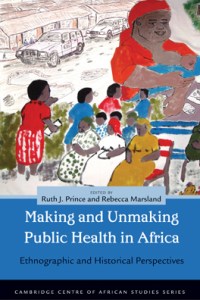
Book cover image via the Ohio University Press website.

Book cover image via the Ohio University Press website.

Prince and Marsland’s edited collection was the result of a 2008 workshop at the University of Cambridge hosted by the Centre of African Studies and the Department of Social Anthropology. Africa has long served as an “arena” for discussions about global health, human rights, and humanitarian aid, but the notion of health-for-all is complicated against a backdrop of African state formation, international interventions, and transnational policies.

This text explores what public health means for clinical professionals, patients, government officials, and citizens throughout Africa. Instead of generalizing what the meaning of public health to these groups might be, this book aims to establish a rich, complex anthropology of African public health that weighs the importance of politics, culture, and local understanding to the definition and delivery of public health initiatives. The volume covers topics in numerous countries including Uganda, Nigeria, Kenya, and Tanzania, and takes a blended historical-anthropological approach to studying public health.


These brief summaries are intended to give our readers a glimpse into the newest academic publications that we’re excited to discuss in our journal and with our followers on social media. For a full list of books that have been submitted for review at CMP, click this link: http://link.springer.com/article/10.1007/s11013-014-9383-x. This page also has information regarding the submissions process for authors who’d like their academic releases reviewed in the journal, as well as information for those interested in composing a review. For more information on this process, please contact managing editor Brandy Schillace.

Current Issue Highlight: September 2014 (Vol 38 Issue 3) Part Two

Welcome back to our two-week special update featuring glimpses into some of the articles published in the latest release of Culture, Medicine, and Psychiatry. These brief synopses of a few of our newest pieces from the September 2014 issue are only some of the publications that the current issue has to offer. We hope they invite you to explore the many other fascinating articles housed in this issue and in past volumes of CMP.

Swapnaushadhi: The Embedded Logic of Dreams and Medical Innovation in Bengal
Projit Bihari Mukharji

Mukharji’s article discusses the prevalent but little-researched history of indigenous therapeutic practices in Bengal that stem from therapies revealed in healers through dreams. Instead of grouping this practice into the indiscriminate category of “indigenous practice” or “dream culture,” the author asserts that all dream cultures are locally specific. They also do not draw stringent religious boundaries, as healers (and their patients) may receive visions of divine figures like Jesus or Muhammed despite not being of the creed the prophet represents. Because of this cross-cultural and “borderless” dialogue, medical innovation in dream medicine occurs regularly as the product of contact between numerous religious, spiritual, and local traditions. As Mukharji argues, “the logic of dreams opens up a space: the swapna-sthana or the dreamland where such cross-boundary transactions can take place without undermining the sanctity of the boundary itself in everyday social life.”

‘‘Pensando Mucho’’ (‘‘Thinking Too Much’’): Embodied Distress Among Grandmothers in Nicaraguan Transnational Families
Kristin Elizabeth Yarris

Yarris chronicles the difficulties faced by Nicaraguan grandmothers serving as the primary caregivers of grandchildren whose mothers have migrated to another country for employment. The author asks us to reconsider the simplistic mind-body connection in lieu of a more complicated view of the body and mind as experiencing distress: physical, emotional, and cultural all at once. In this paper, we discover that the term “thinking too much” ultimately describes the difficult self-sacrifice faced by grandmothers who tend to their grandchildren to allow their own children to succeed elsewhere. The stress of geographically dispersed and fractured families, the burden of caregiving later in life, and anxieties surrounding the grandmothers’ “hopes for the future” generate a particular form of psychosomatic suffering connected to broader economic, social, and political pressures manifested at the local level among these Nicaraguan families.